AEO and GEO for business growth are becoming important considerations for businesses adapting to AI-powered search in 2027. By combining Answer Engine Optimization (AEO) and Generative Engine Optimization (GEO) with traditional SEO, businesses can improve online visibility, build brand credibility, and reach potential customers.
As a digital marketer, I believe understanding how people discover and evaluate businesses online is just as important as understanding how websites rank in search results. Through my digital marketing training and practical work involving website audits, SEO, and digital marketing strategy, I have learned to look beyond rankings and consider the overall website experience, content quality, and clarity of a brand’s information. This perspective has encouraged me to explore how AEO and GEO can help businesses adapt to changing search behavior, strengthen their online presence, and achieve better business growth beyond traditional SEO.
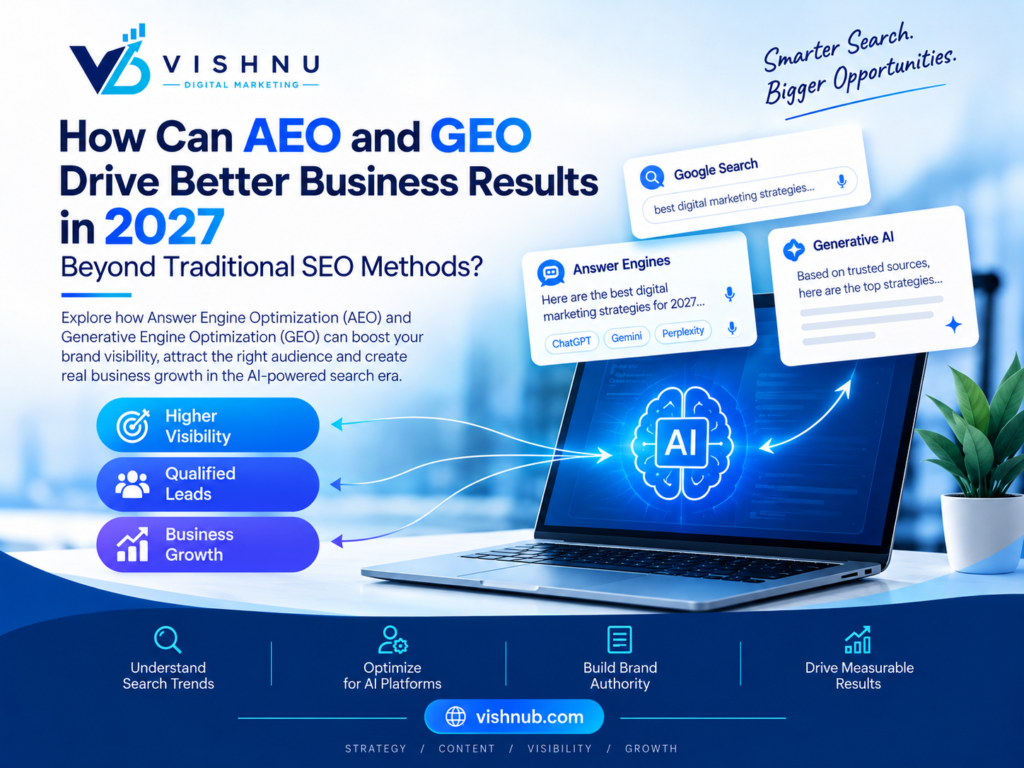
Table of Contents
How AEO and GEO Strategies Support Business Growth?
Before building a strategy, it helps to define the terms clearly, because they are often used interchangeably even though they solve slightly different problems.
What Is Answer Engine Optimization (AEO)?
Answer Engine Optimization is the practice of structuring your content so that search engines, voice assistants, and AI tools can extract it as a direct, concise answer. Think featured snippets, “People Also Ask” boxes, voice responses, and the short answer at the top of an AI Overview.
AEO rewards clarity. A page that states a question, answers it in two or three plain sentences, and then expands with supporting detail is far easier for an answer engine to lift and trust.
What Is Generative Engine Optimization (GEO)?
Generative Engine Optimization focuses on earning mentions, citations, and recommendations inside responses written by large language models. Instead of ranking a page, you are trying to become a source the model draws on when it composes an original answer.
GEO rewards authority and consensus. Models tend to cite brands and publications that are referenced consistently across many credible places, not just those with a well-optimized homepage.
AEO vs GEO vs SEO: A Quick Comparison
Understanding AEO vs GEO vs SEO prevents wasted effort, because each discipline targets a different surface and measures success differently.
• Traditional SEO: Aims to rank web pages in a list of results. Success is measured in rankings, organic clicks, and sessions.
• AEO: Aims to be the single, direct answer shown by search features and voice assistants. Success is measured in snippet ownership, answer impressions, and zero-click visibility.
• GEO: Aims to be cited or recommended inside AI-generated responses. Success is measured in brand mentions, citation frequency, and share of voice across AI platforms.
The important point is that these are not rivals. SEO builds the technical and content foundation; AEO and GEO build on top of it to capture the new ways people find information.
Why Traditional SEO Alone Is No Longer Enough in 2027
Traditional SEO still matters. Crawlability, page speed, quality content, and backlinks remain the entry ticket. But relying on them alone leaves real gaps. Need to use AEO and GEO For Business Growth.
• Zero-click behavior is growing. Many queries are now fully answered on the results page or inside an AI chat, so rankings no longer guarantee traffic.
• Discovery is fragmenting. Buyers research across AI assistants, social platforms, review sites, and communities before they ever visit your website.
• Shortlists are shrinking. An AI assistant might recommend three vendors instead of showing ten links. Being left off that short list costs you the lead entirely.
• Visitors arrive further along. People who do click from an AI answer have usually done much of their research already, so they tend to be more qualified.
Businesses that AEO and GEO for Business Growth as an extension of SEO, rather than a replacement, are the ones best positioned to adapt.
What My Website Audit Experience Has Taught Me
While working on a website audit for a business, I examined several elements that contribute to a website’s overall digital presence, including content, social media connections, tracking opportunities, and structured data. This helped me recognize that improving online visibility involves more than optimizing individual pages for keywords. Businesses also need clear and consistent information, a technically sound website, and a trustworthy presence across relevant platforms.
Although these checks do not directly prove AI search visibility, they are useful starting points when assessing whether a business has the foundations needed to explore AEO and GEO for Business Growth. My approach is to identify existing gaps first, prioritize improvements, and then evaluate how those improvements support the business’s broader digital marketing goals.
Key Benefits of AEO and GEO for Business Growth
Implementing AEO and GEO for business growth helps businesses improve AI search visibility, establish credibility, attract relevant audiences, and discover new opportunities to generate leads.
Stronger AI Search Visibility
AEO and GEO for Business Growth help your brand appear in AI-generated answers when potential customers search for recommendations, increasing visibility and creating opportunities to attract qualified buyers. This kind of AI search visibility builds awareness even when no click occurs.
Higher-Quality Leads
Users who reach your site after an AI assistant has already summarized your strengths are typically better informed. That often shortens the sales conversation and improves conversion rates by doing AEO and GEO for Business Growth.
Greater Brand Authority and Trust
When multiple AI platforms repeatedly mention your brand as a reliable source, it reinforces credibility in a way that a single ranking position cannot.
Resilience Against Algorithm and Platform Shifts
Diversifying across classic search, answer features, and generative platforms reduces your dependence on any one traffic source.
Better Content Efficiency
Content built around real questions and clear answers serves all channels at once: organic search, voice, AI summaries, sales enablement, and customer support.
Core Features of an Effective Strategy: AEO and GEO for Business Growth
A strong program shares a handful of recognizable characteristics. These are the core features of an effective AEO and GEO for business Growth.
• Question-led content architecture: Pages organized around the exact questions your audience asks, each answered directly near the top.
• Structured data and schema markup: FAQ, Article, Organization, Product, and HowTo schema help machines understand context and relationships.
• Entity clarity: Consistent naming, descriptions and facts about your brand, authors and products across your site and the wider web.
• Original, citable asset: Proprietary data, case studies, benchmarks and expert commentary that other sources want to reference.
• Authoritative off-site presence: Mentions in trusted publications, industry directories, review platforms and communities.
• Clean technical foundation: Fast, accessible, crawlable pages that AI crawlers can read without friction.
Step-by-Step Guide to Implementing AEO and GEO for Business Growth
Use this practical roadmap to move from theory to execution.
Step 1: Evaluate Your Brand’s Visibility Across AI Search Platforms.
Start by testing real prompts. Ask major AI platforms the questions your customers ask, such as “best [your category] for [use case]” or “how do I solve [problem]?” Record whether your brand appears, how it is described, and which competitors and sources are cited instead.
Step 2: Map the Questions Your Audience Asks
Gather questions from sales calls, support tickets, Search Console queries, “People Also Ask” boxes, and community forums. Group them by funnel stage: awareness, comparison, and decision
Step 3: Create Direct, Answer-First Content
For each priority question, write a clear answer of roughly 40 to 60 words at the top of the section, followed by deeper explanation, examples, and evidence.
Step 4: Add Structured Data
Implement relevant schema markup and validate it. Make sure author, publisher, and organization details are marked up accurately so your entity information is unambiguous.
Step 5: Strengthen Your Brand’s Credibility Across External Platforms
By doing AEO and GEO for Business Growth. Generative Engine Optimization, focus on earning credible mentions. This includes expert quotes in industry articles, guest contributions, podcasts, original research that others cite, and well-maintained profiles on review and directory sites.
Step 6: Strengthen Your E-E-A-T Signals
Show real experience and expertise. Include author bios with credentials, cite reliable sources, publish first-hand case studies, keep contact and policy pages transparent, and update older content regularly.
Step 7: Measure, Learn and Iterate
Track how often your brand is mentioned in AI answers, the sentiment of those mentions, snippet ownership, referral traffic from AI platforms, and, most importantly, the leads and revenue connected to them. Repeat your prompt audit monthly.
Best Practices of AEO and GEO for Business Growth in 2027
These habits separate sustainable programs from short-lived experiments for AEO and GEO for Business Growth.
1. Lead with the answer. Put the most useful sentence first, then support it.
2. Write in natural language. Mirror how people actually speak and type their questions.
3. Use clear headings. Descriptive H2 and H3 headings help both readers and machines navigate your content.
4. Back claims with evidence. Statistics, named sources, and dated references increase the likelihood of being trusted and cited.
5. Keep content fresh. Review and update key pages at least quarterly so facts stay current.
6. Be consistent everywhere. Align your brand description, pricing language, and key facts across your website, profiles, and press mentions.
7. Allow responsible AI crawling. Review your robots.txt and access settings so legitimate AI crawlers can reach the content you want cited.
8. Optimize for people first. If a page is genuinely helpful to a human reader, it is already halfway to being useful to an AI system.
Common Mistakes to Avoid
These are the common mistakes that need to be avoided in AEO and GEO for Business Growth.
• Abandoning SEO fundamentals. AEO and GEO depend on a healthy technical and content base. Neglecting it weakens everything else.
• Keyword stuffing or prompt stuffing. Repeating phrases unnaturally harms readability and offers no advantage with modern language models.
• Publishing thin, generic content. AI systems favor sources that add original insight, not rewritten summaries of what already exists.
• Ignoring off-site reputation. GEO is heavily influenced by what the wider web says about you, not only what you say about yourself.
• Skipping measurement. Without a baseline and regular checks, you cannot tell what is working.
• Chasing every platform at once. Focus first on the AI tools your audience actually uses.
• Treating AI answers as guaranteed. Outputs vary by platform, prompt, and time, so think in terms of trends rather than fixed rankings.
Many teams stumble in the same predictable ways when starting with AI-driven digital marketing used in AEO and GEO for Business Growth.
• Abandoning SEO fundamentals. AEO and GEO depend on a healthy technical and content base. Neglecting it weakens everything else.
• Keyword stuffing or prompt stuffing. Repeating phrases unnaturally harms readability and offers no advantage with modern language models.
• Publishing thin, generic content. AI systems favor sources that add original insight, not rewritten summaries of what already exists.
• Ignoring off-site reputation. GEO is heavily influenced by what the wider web says about you, not only what you say about yourself.
• Skipping measurement. Without a baseline and regular checks, you cannot tell what is working.
• Chasing every platform at once. Focus first on the AI tools your audience actually uses.
• Treating AI answers as guaranteed. Outputs vary by platform, prompt, and time, so think in terms of trends rather than fixed rankings.
Expert Tips to Get Ahead
• Publish something only you can say. Original data, customer outcomes, and practitioner opinions are far more citable than general advice.
• Create comparison and “best for” content honestly. Buyers frequently ask AI tools to compare options, so fair, well-structured comparisons earn trust.
• Make authors visible. Real names, credentials, and experience give both readers and algorithms reasons to trust the content.
• Repurpose answers across formats. A strong answer can become an FAQ entry, a short video, a podcast segment, and a sales one-pager.
• Involve subject-matter experts. Quotes and reviews from practitioners add the first-hand experience that generic content lacks.
How to Measure Business Results from AEO and GEO For Business Growth
Since traditional ranking metrics don’t show the complete performance, include these additional indicators in your reports.
• AI share of voice: The percentage of tested prompts in which your brand is mentioned compared with competitors.
• Citation count and quality: How often your pages are linked or referenced, and by which platforms.
• Answer and snippet ownership: The number of featured snippets and answer boxes you hold.
• Branded search growth: An increase in people searching for your name after seeing it in AI answers.
• Assisted conversions: Leads and sales where AI platforms appeared in the customer journey.
Frequently Asked Questions (FAQs)
What Sets Answer Engine Optimisation (AEO) Apart from Generative Engine Optimisation (GEO)?
AEO aims to position your content as a clear, direct response in search results and voice assistant answers. GEO focuses on being cited or recommended inside AI-generated responses. Both rely on clear, trustworthy, well-structured content.
Is SEO still important in 2027?
Yes. SEO remains the foundation because AI systems and answer engines draw on crawlable, high-quality, authoritative content.AEO and GEO complement traditional SEO by expanding its reach across AI-powered search platforms rather than replacing it.
How Much Time Does AI Search Optimisation Take to Show Measurable Results?
Timelines vary by industry and competition. Many businesses see early movement in snippets and mentions within a few months, while building consistent AI search visibility usually takes longer because it depends on broader authority signals.
Can AEO and GEO Help Small Businesses Improve Their Online Visibility?
Absolutely, AEO and GEO for Business Growth and their online visibility. Small businesses often win by answering niche, local, or highly specific questions in more depth and with more genuine experience than larger competitors.
Are Any Specific Tools Required to Get Started?
Not necessarily. You can begin with manual prompt testing, a spreadsheet, and basic schema validation. Dedicated AI visibility tracking tools can help as your program scales.
Does AI-generated content help with AEO and GEO for Business Growth?
AI can assist with drafting and research, but content that ranks and gets cited needs human expertise, original insight, and careful fact-checking. Publishing unedited generic text rarely earns trust.
Conclusion: Start Building Your AI Search Helps AEO and GEO for Business Growth
From my perspective as a digital marketer, the future of search is not about abandoning traditional SEO in favor of every new trend. It is about understanding how people discover information, building a strong online presence, and creating content that genuinely answers their questions. AEO and GEO offer additional ways to approach this challenge, but businesses still need reliable information, helpful content, sound technical foundations, and consistent measurement. For businesses looking ahead to 2027, AEO and GEO for business growth offer additional ways to strengthen online visibility while complementing traditional SEO strategies.
My recommendation is to start with the fundamentals, identify the questions that matter most to your audience, and test new optimization approaches gradually. By combining traditional SEO with answer-focused content and a broader approach to brand visibility, businesses can prepare for changing search experiences while keeping their attention on the outcomes that matter most: trust, qualified leads, and sustainable growth.